Wednesday, October 16, 2024

MPI - Geometry

Day 7 of the Mathematics Practice Intensive was on the topic of Geometry.  There are many aspects of what qualifies as Geometry including 2D shapes, 3D shapes, angles, transformation, position and orientation.

We began as usual with a Maths Talk strategy.  Today's one was Quick Images or Subitising.  This is when you display an image of some sort (one that has items that can be counted) and then you take it away after about 3 seconds and the students work out how many objects were in the image.  The conversations are very interesting around how students saw the items and then how they worked out how many items there were.  The Jo Boaler video below was an excellent example of how you could carry out one of these Maths Talk sessions.


Just like I found with measurement, the strand of geometry is very vocabulary heavy.  This will mean ensuring I am using the TIP charts. lots of repetition and perhaps integrating some of it into my Literacy programme...just a thought!
Reading back over my last blog post about measurement I said that I was going to plan a week's worth of workshops and a rich task all about angles and teach it to the whole hub.  Success!  I did exactly that and so now because angles is also part of the geometry strand I am going to add onto that learning and cover the interior angles of triangles and quadrilaterals with my students.  
I was amazed by the amount of online tools that we can use while teaching geometry.  I had used a Maths Playground activity this week where the students used a virtual protractor to measure angles. I will be looking at what other tools I can use when we look at the interior angles learning next.
My mind is whirring away at the homework task where we need to bring an integrated maths lesson.  Do I link it to my angle teaching and learning somehow or go somewhere else entirely?!  Watch this space!

Wednesday, September 18, 2024

MPI - Measurement

Day 6 in the Mathematics Practice Intensive was all about Measurement.  I don't think I had connected how much you can use multiplicative thinking and working out during the Measurement topic.  This got me thinking about integrating strands (again!) and that perhaps this would be a great one to integrate into next term's teaching and learning because I want to go back over addition, subtraction, multiplication and division.  We have already 'done' measurement this year but how good to be able to cover it again and add new learning or consolidate the learning already covered.  The part that stood out to me was the perimeter and area part.  Perimeter is all about adding but also stepping it up if possible and using multiplication.  I will also make sure that I am making the connections between arrays and area.  Two birds, one stone, as they say!

Some thing else that really resonated with me was the teaching of angles.  I am going to create a one week whole class/hub sequence of lessons on this.  We will do learning around the vocabulary leading into actually measuring angles.  I am thinking I will plan four days of good explicit teaching lessons and then make the fifth day a rich task.  I am actually quite excited about this and think it will be a great first week back next term topic for maths.

Our new Maths Talks strategy was Number Strings.  The first one I have planned to try was actually one that was in a video shared with us today.  It fits so well with multiplication and arrays.  It's also a great one as a stepping stone for using place value to multiply numbers and using times tables we know to work out other equations.
So once again, leaving the MPI day armed with things to try and lots of resources to still explore!

Wednesday, August 28, 2024

Algebraic Thinking

 Day 5 in the Mathematics Practice Intensive covered all things algebraic!    

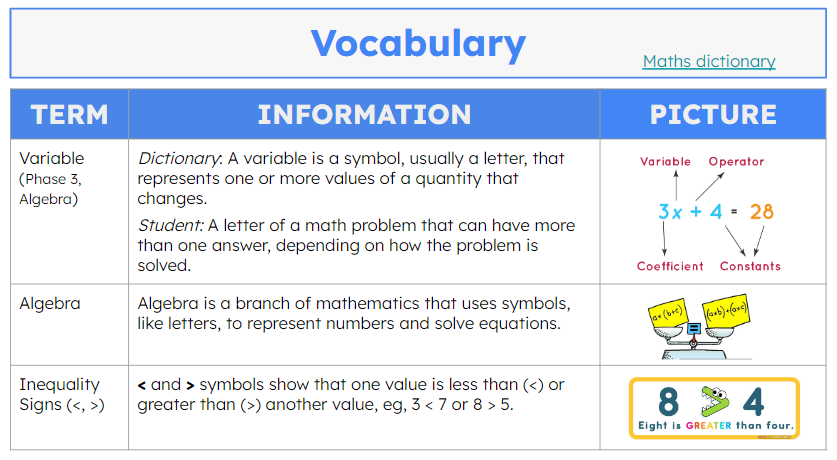
The biggest take away for me was the vocabulary.  This also linked with something that someone said today and I thought about how often I talk about this with my colleagues too - "Lots of students can do the maths, they just don't understand the vocabulary.  They don't understand what they are being asked to do in the question/maths problem"  I can see the value in using TIP charts a lot more regularly in my programme and a lot more revising of vocabulary.  

I also hadn't thought about the fact that all those symbols that we use daily in maths are actually crucial for algebra and also crucial for students to actually understand what they mean.  For example the good old equals sign not just meaning that something equals something else but that two sides balance, they are the same. 
I think it has been fair to say that Algebra has been a strand of maths that we teach but perhaps as a stand alone topic when it should be integrated throughout.  If you actually look at what algebra is, we are teaching it throughout our maths programme but I don't think we are being specific enough about it being algebra.  The changes I am going to make to specifically teach the vocabulary that goes with it and what it is, will hopefully stop students from feeling like algebra is a topic to be feared!  

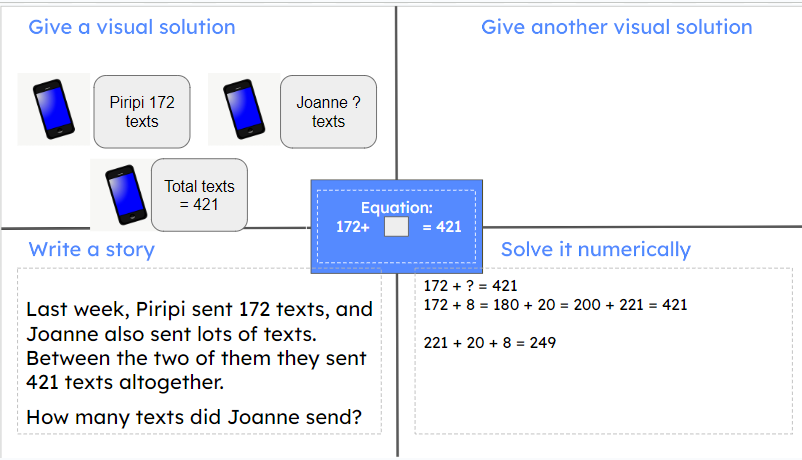
The brilliance of algebra problems is that they can also be used to cover some choral counting, shared visual representations of what problems actually mean and number talk strategies.  

I am heading away to rethink my maths sessions.  Is there a way that I can include the choral counting, number talk strategies and algebraic concepts/vocabulary more regularly into my maths daily/weekly planning?

Wednesday, August 7, 2024

Number : Whole and Rational

Day 4 in the Mathematics Practice Intensive covered Number but more explicitly the parts of number that our students find to be their sticking points, those parts of number that students seem to struggle with.  So as you can probably guess this included Place Value, Fractions, Decimals, Percentages and Integers.

Dorothy's reminder of what RAT stands for was very timely and it is always great to refresh your knowledge of our Manaiakalani pedagogy.  Recognise Effective Practice, Amplify Effective Practice and Turbocharge Effective Practice.  I really thought about the Turbocharging part of our teaching and learning today and how I can really embed students reflecting on their learning through the use of our technology and also building up their confidence in their maths discussions.

Choral Counting was a great reminder...another one of those strategies that I used to do but has been lost along the way somewhere.  I can see that this will be brilliant to bring back as I start to teach my students about fractions and decimals.  

New learning for me today was something called a TIP chart.  I have used something similar but have never come across the TIP acronym before.  This will definitely be added to my teacher toolkit for weekly planning and not just in maths, I can see it being used very nicely in lots of areas.
My focus going forward is to complete some teaching and learning in the areas of fractions and decimals to see where my students' knowledge is.  I will be finding all of those manipulatives - physical and digital - to make this journey as clear as possible.

Wednesday, June 26, 2024

Planning a Maths Programme

Day 3 in the Mathematics Practice Intensive was all about Planning a Maths Programme.  Not, here is what you need to do, now go and do it but here are all the options and resources, choose what is best for you and your students and go and do it.  

It's amazing after each day of this intensive learning in maths how my thinking and reflecting on best practice is altering and my list of what I would like to change or freshen up, as we keep saying, is swirling around in my head.  I have that slightly annoying quality that really makes me want to freshen it all up immediately and be doing it as perfectly as possible (What would that look like...different in every teaching space around the country!)  I have to be sensible and change it bit by bit and mold it into a maths programme that I am happy with and is ensuring engagement and success for my learners.

Today we covered The Joys of Timetabling, Grouping, Planning for a Rich Task and Follow up Learning.  Structuring your maths week so you are fitting in workshops, oral language, rich tasks in flexible groupings and then some investigation tasks just seems to hit all the right targets for me.  

Moving forward I am going to continue to tweak my Task Board to include some more of the learning from today, mostly around the follow up tasks and basic facts resources that are available.  I will also move towards introducing a rich task and I like the idea of doing this on a Thursday because I could structure my workshops around the mathematical skills and strategies that could be useful to solve the problem.  Thank you to Sarah, who is on this journey with me, for suggesting that you could tell the group the problem and then the answer so it becomes about the best strategies to use to get to the answer, rather than the fastest person to solve the problem.  I am hoping that the injection of real contexts, rich tasks, more talking and investigations will switch my learners from feeling ok about maths to thinking it is pretty cool!

Right, I am signing off for now and will be checking out the resources above to create a Rich Task to share for homework:)

Wednesday, June 5, 2024

Know our learners as mathematicians

Day 2 of the Maths Practice Intensive was all about knowing our learners as mathematicians.  I have to keep reminding myself that it is called 'Intensive' for a particular reason!  We work through a lot of material in a relatively short space of time but I know that I will digest and revisit over the next three weeks before our next session and it will all start to sink in and make sense as more and more of the course is delivered to us.  One of my big take-aways is the fact that I am being delivered all of this research based material and I can pick and choose as to what will suit me and my class at this point.  Speaking of which, how fantastic do these slides look?  I am very keen to be working towards my planning for my students to be as enticing and interesting as the examples that we are having shared with us.


If this is the learning that they are being invited to be part of, then I will easily be motivating my learners to engage with the curriculum, know what their next steps are and to negotiate with them the best ways for them to reach these goals.
The wealth of knowledge we have at our fingertips through the assessment that we do is waiting and ready for us to use.  We just need some knowledge on how to use this.  Today we started creating our own Teacher Workbooks which will become a collection of data, next steps, learning intentions, and resource ideas.  This will be one of the areas where I will need to look at what works for me and build onto this as and when needed. 
I am off to have a go at creating a task board that I can start using tomorrow.  I think I need another long weekend...😄😄

What kind of mathematician are you?

As part of the MPI first day homework I got each of my Year 5 and 6 students to carry out a survey on a variety of questions about their attitude towards maths.  It was a quick and easy activity to carry out but has brought a wealth of information about their attitude to maths out in the open for us to work on.

My initial thought is that I need to think really hard about how I am presenting the maths curriculum to my students to ensure I can move some of my students' attitudes towards things like how confident they are, how often they get to discuss their ideas and strategies, what really helps them learn and how often they feel like they are getting feedback from me.

The question about how often they practice maths at home was very interesting and it was the question which saw most of the students rate themselves on the lower end of the scale.  I do wonder if they know that maths can be other things than just online apps etc.  I need to revisit the first blog post I wrote after my first MPI Day and look at what connections I can start making between maths topics and concepts, and also between maths and everyday life.

A question we are debating is if we find maths a bit challenging can we still like it?  We will keep you updated with what we decide.😃

MPI - Create and Share in Mathematics

  Our last day of the Mathematics Practice Intensive for 2024!  I have to be honest and say that I will miss the sessions and all of the won...