Wednesday, November 20, 2024

MPI - Create and Share in Mathematics

 Our last day of the Mathematics Practice Intensive for 2024!  I have to be honest and say that I will miss the sessions and all of the wonderful learning that has transpired.  My goal is to now use all of it in an absolutely amazing year of maths next year!

We learnt about another example of Maths Talks which was all around Images.  I can really see that my students are going to enjoy these activities and the chance to be detectives and really investigate all of the maths they can see in some really great images.  We were shared lots of great places in which to find these images.

An image that really resonated with me today was the brain image that really summed up being creative.  I actually think I will use it with my students too, it might even become our symbol for meaning Create.

I was also thinking that I want to have a visual presentation of all the different ways that students can create next year too.  Maybe as simple as having a section of wall where I add in the logos of the different sites etc. that they could use.  This could then ensure variety and choice in their Create Tasks.
When we are planning for these create tasks we also need to go through the process of:
  • Active Verb
  • Object Created
  • Purpose
  • Audience/End User
  • Constraints
This will ensure we are creating opportunities for more genuine learning in our create tasks.

I am still working on the Sharing part of the equation.  I am leaving today's session with renewed focus on ensuring that my students' learning is shared in some way, this could be on their blog, this could be orally, but whatever it looks like, it is a very important part of the whole learning journey.

So, although it is the end of the MPI, I feel like it is only the beginning of my maths journey!!  I will leave for now with a quote that resonated with me:

Mathematics is not about numbers, equations, computations, or algorithms: it is about understanding.
— William Paul Thurston, American mathematician  

Wednesday, November 6, 2024

MPI - Statistics and Probability

MPI Day 8 was all about Statistics and Probability.  I really enjoyed today and it seemed to fly.  Statistics just seems so much easier to digest and teach than the likes of Geometry and Measurement which have so many parts to them.  

The Maths Talks focus was on Data Talks and I thought the examples shared with us were really great.  I can't believe I have never thought to add this into my programme before.  I really feel like I need to be smart about how I integrate all the Maths Talks examples into my daily programme and perhaps not just in maths time.  Keep it topical...there would be lots of data that could be shared at the moment about the US election, with summer heading our way there will be data about weather and temperatures and then perhaps Christmas present popularity data!

I also really liked the connections made with Critical Thinking.  Teaching students to take in the information or data with their smart critical thinking hats on.  Thinking about if the graph is a fair representation of what the data is actually telling us?


The CensusAtSchool site will definitely be getting a good look at for the beginning of next year.  From the Fabulous Feet lesson to Data Cards, lots of really great resources and ideas for teaching Statistics.

Right I am off to plan a few Probability lessons and hope that they become my most successful maths lessons ever that I can share in the next session!

Wednesday, October 16, 2024

MPI - Geometry

Day 7 of the Mathematics Practice Intensive was on the topic of Geometry.  There are many aspects of what qualifies as Geometry including 2D shapes, 3D shapes, angles, transformation, position and orientation.

We began as usual with a Maths Talk strategy.  Today's one was Quick Images or Subitising.  This is when you display an image of some sort (one that has items that can be counted) and then you take it away after about 3 seconds and the students work out how many objects were in the image.  The conversations are very interesting around how students saw the items and then how they worked out how many items there were.  The Jo Boaler video below was an excellent example of how you could carry out one of these Maths Talk sessions.


Just like I found with measurement, the strand of geometry is very vocabulary heavy.  This will mean ensuring I am using the TIP charts. lots of repetition and perhaps integrating some of it into my Literacy programme...just a thought!
Reading back over my last blog post about measurement I said that I was going to plan a week's worth of workshops and a rich task all about angles and teach it to the whole hub.  Success!  I did exactly that and so now because angles is also part of the geometry strand I am going to add onto that learning and cover the interior angles of triangles and quadrilaterals with my students.  
I was amazed by the amount of online tools that we can use while teaching geometry.  I had used a Maths Playground activity this week where the students used a virtual protractor to measure angles. I will be looking at what other tools I can use when we look at the interior angles learning next.
My mind is whirring away at the homework task where we need to bring an integrated maths lesson.  Do I link it to my angle teaching and learning somehow or go somewhere else entirely?!  Watch this space!

Wednesday, September 18, 2024

MPI - Measurement

Day 6 in the Mathematics Practice Intensive was all about Measurement.  I don't think I had connected how much you can use multiplicative thinking and working out during the Measurement topic.  This got me thinking about integrating strands (again!) and that perhaps this would be a great one to integrate into next term's teaching and learning because I want to go back over addition, subtraction, multiplication and division.  We have already 'done' measurement this year but how good to be able to cover it again and add new learning or consolidate the learning already covered.  The part that stood out to me was the perimeter and area part.  Perimeter is all about adding but also stepping it up if possible and using multiplication.  I will also make sure that I am making the connections between arrays and area.  Two birds, one stone, as they say!

Some thing else that really resonated with me was the teaching of angles.  I am going to create a one week whole class/hub sequence of lessons on this.  We will do learning around the vocabulary leading into actually measuring angles.  I am thinking I will plan four days of good explicit teaching lessons and then make the fifth day a rich task.  I am actually quite excited about this and think it will be a great first week back next term topic for maths.

Our new Maths Talks strategy was Number Strings.  The first one I have planned to try was actually one that was in a video shared with us today.  It fits so well with multiplication and arrays.  It's also a great one as a stepping stone for using place value to multiply numbers and using times tables we know to work out other equations.
So once again, leaving the MPI day armed with things to try and lots of resources to still explore!

Wednesday, August 28, 2024

Algebraic Thinking

 Day 5 in the Mathematics Practice Intensive covered all things algebraic!    

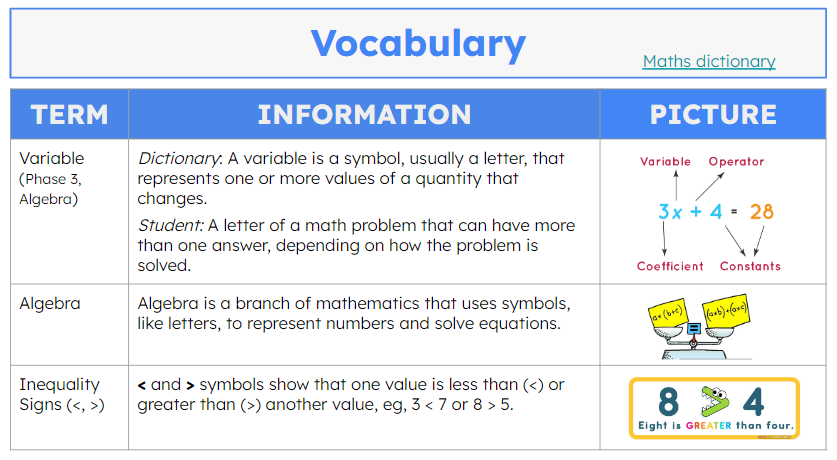
The biggest take away for me was the vocabulary.  This also linked with something that someone said today and I thought about how often I talk about this with my colleagues too - "Lots of students can do the maths, they just don't understand the vocabulary.  They don't understand what they are being asked to do in the question/maths problem"  I can see the value in using TIP charts a lot more regularly in my programme and a lot more revising of vocabulary.  

I also hadn't thought about the fact that all those symbols that we use daily in maths are actually crucial for algebra and also crucial for students to actually understand what they mean.  For example the good old equals sign not just meaning that something equals something else but that two sides balance, they are the same. 
I think it has been fair to say that Algebra has been a strand of maths that we teach but perhaps as a stand alone topic when it should be integrated throughout.  If you actually look at what algebra is, we are teaching it throughout our maths programme but I don't think we are being specific enough about it being algebra.  The changes I am going to make to specifically teach the vocabulary that goes with it and what it is, will hopefully stop students from feeling like algebra is a topic to be feared!  

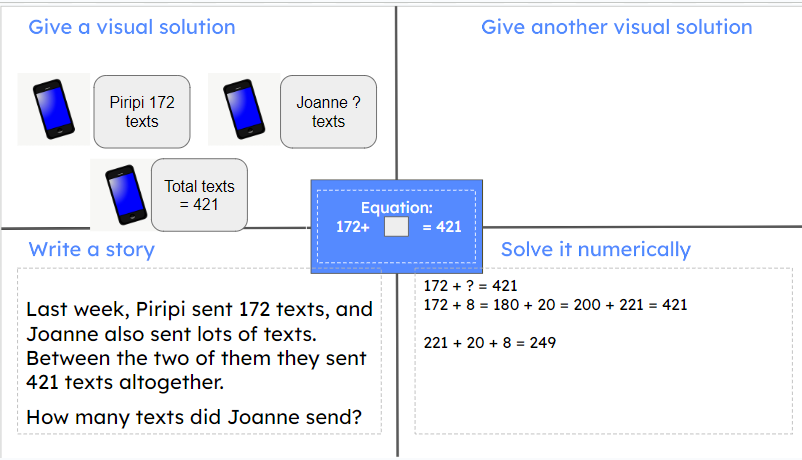
The brilliance of algebra problems is that they can also be used to cover some choral counting, shared visual representations of what problems actually mean and number talk strategies.  

I am heading away to rethink my maths sessions.  Is there a way that I can include the choral counting, number talk strategies and algebraic concepts/vocabulary more regularly into my maths daily/weekly planning?

Wednesday, August 7, 2024

Number : Whole and Rational

Day 4 in the Mathematics Practice Intensive covered Number but more explicitly the parts of number that our students find to be their sticking points, those parts of number that students seem to struggle with.  So as you can probably guess this included Place Value, Fractions, Decimals, Percentages and Integers.

Dorothy's reminder of what RAT stands for was very timely and it is always great to refresh your knowledge of our Manaiakalani pedagogy.  Recognise Effective Practice, Amplify Effective Practice and Turbocharge Effective Practice.  I really thought about the Turbocharging part of our teaching and learning today and how I can really embed students reflecting on their learning through the use of our technology and also building up their confidence in their maths discussions.

Choral Counting was a great reminder...another one of those strategies that I used to do but has been lost along the way somewhere.  I can see that this will be brilliant to bring back as I start to teach my students about fractions and decimals.  

New learning for me today was something called a TIP chart.  I have used something similar but have never come across the TIP acronym before.  This will definitely be added to my teacher toolkit for weekly planning and not just in maths, I can see it being used very nicely in lots of areas.
My focus going forward is to complete some teaching and learning in the areas of fractions and decimals to see where my students' knowledge is.  I will be finding all of those manipulatives - physical and digital - to make this journey as clear as possible.

Wednesday, June 26, 2024

Planning a Maths Programme

Day 3 in the Mathematics Practice Intensive was all about Planning a Maths Programme.  Not, here is what you need to do, now go and do it but here are all the options and resources, choose what is best for you and your students and go and do it.  

It's amazing after each day of this intensive learning in maths how my thinking and reflecting on best practice is altering and my list of what I would like to change or freshen up, as we keep saying, is swirling around in my head.  I have that slightly annoying quality that really makes me want to freshen it all up immediately and be doing it as perfectly as possible (What would that look like...different in every teaching space around the country!)  I have to be sensible and change it bit by bit and mold it into a maths programme that I am happy with and is ensuring engagement and success for my learners.

Today we covered The Joys of Timetabling, Grouping, Planning for a Rich Task and Follow up Learning.  Structuring your maths week so you are fitting in workshops, oral language, rich tasks in flexible groupings and then some investigation tasks just seems to hit all the right targets for me.  

Moving forward I am going to continue to tweak my Task Board to include some more of the learning from today, mostly around the follow up tasks and basic facts resources that are available.  I will also move towards introducing a rich task and I like the idea of doing this on a Thursday because I could structure my workshops around the mathematical skills and strategies that could be useful to solve the problem.  Thank you to Sarah, who is on this journey with me, for suggesting that you could tell the group the problem and then the answer so it becomes about the best strategies to use to get to the answer, rather than the fastest person to solve the problem.  I am hoping that the injection of real contexts, rich tasks, more talking and investigations will switch my learners from feeling ok about maths to thinking it is pretty cool!

Right, I am signing off for now and will be checking out the resources above to create a Rich Task to share for homework:)

Wednesday, June 5, 2024

Know our learners as mathematicians

Day 2 of the Maths Practice Intensive was all about knowing our learners as mathematicians.  I have to keep reminding myself that it is called 'Intensive' for a particular reason!  We work through a lot of material in a relatively short space of time but I know that I will digest and revisit over the next three weeks before our next session and it will all start to sink in and make sense as more and more of the course is delivered to us.  One of my big take-aways is the fact that I am being delivered all of this research based material and I can pick and choose as to what will suit me and my class at this point.  Speaking of which, how fantastic do these slides look?  I am very keen to be working towards my planning for my students to be as enticing and interesting as the examples that we are having shared with us.


If this is the learning that they are being invited to be part of, then I will easily be motivating my learners to engage with the curriculum, know what their next steps are and to negotiate with them the best ways for them to reach these goals.
The wealth of knowledge we have at our fingertips through the assessment that we do is waiting and ready for us to use.  We just need some knowledge on how to use this.  Today we started creating our own Teacher Workbooks which will become a collection of data, next steps, learning intentions, and resource ideas.  This will be one of the areas where I will need to look at what works for me and build onto this as and when needed. 
I am off to have a go at creating a task board that I can start using tomorrow.  I think I need another long weekend...😄😄

What kind of mathematician are you?

As part of the MPI first day homework I got each of my Year 5 and 6 students to carry out a survey on a variety of questions about their attitude towards maths.  It was a quick and easy activity to carry out but has brought a wealth of information about their attitude to maths out in the open for us to work on.

My initial thought is that I need to think really hard about how I am presenting the maths curriculum to my students to ensure I can move some of my students' attitudes towards things like how confident they are, how often they get to discuss their ideas and strategies, what really helps them learn and how often they feel like they are getting feedback from me.

The question about how often they practice maths at home was very interesting and it was the question which saw most of the students rate themselves on the lower end of the scale.  I do wonder if they know that maths can be other things than just online apps etc.  I need to revisit the first blog post I wrote after my first MPI Day and look at what connections I can start making between maths topics and concepts, and also between maths and everyday life.

A question we are debating is if we find maths a bit challenging can we still like it?  We will keep you updated with what we decide.😃

Wednesday, May 15, 2024

2024 MPI

 Day 1 : Maths is Core to Learning

The first cohort for Mathematics Practice Intensive launched today!  We had a very full day learning about how maths is core to learning and getting a good understanding of where we are headed in this professional learning adventure.

We began our day with introductions and learning a little bit about each other.  Due to the fact that it is a Manaiakalani initiative and I am in my fifth year of teaching in a Manaiakalani school, some of the names and faces were familiar.  Dorothy shared some of Manaiakalani's Kaupapa and Shared Pedagogy, which is always a good reminder of where this all started and how lucky we are to be on this journey together.  Something that has stuck with me from this is the fact that we need to get these students learning, we need to find out how to do this in the best possible way and we need to do it now.

We started with thinking about what the profile is of a good mathematician.  The attributes were then shared with us which included wonderful vocabulary such as creatively, critically, logically, structure, organise, processing, investigate, understand and the list goes on.  I was thinking about how lots of these are how we could describe what we want from all areas of the curriculum.
Looking at Mathematics across the Curriculum was very interesting.  A wee bonus was finding out that all along on NZ Maths there have been resources, lesson plans etc. that are well thought out series of lessons that do just that - link maths across different curriculum areas.  This will definitely be something I will revisit as I get the big picture of where I am headed sorted.

We had several texts shared with us to choose one to read.  I chose to read Making Connections Strengthens Learning/Mathematics Framework. 

Unless we focus on making connections, “students may view their learning of maths as the accumulation of unrelated and discrete ideas.” (Project Math).


So essentially we need to be helping students make connections between not only maths topics and concepts but also between maths and other curriculum areas, and maths and everyday life. (This reading also included some really simple ways to make connections.)

As I head away to digest the day's material I am very excited about the rich and informative content that we have had shared with us today.  


Sunday, November 19, 2023

Looking back at MIT 2023

This year I was very fortunate to be a part of the Manaiakalani Innovative Teachers 2023. I was one of five other teachers from around New Zealand to take part in this project this year. 

We began our journey in Omaha, getting to know each other and starting with a Design Thinking Process to help us make a start and to work out what we might want to work on for the duration of the year.  We achieved so much in these couple of days and we felt excited and ready to get started on our projects.  Each term we met in Auckland at KPMG to share our progress and work through any issues we were having with our fellow MIT colleages. 

At the beginning of the Term 3 holidays we headed to the Bay of Islands to present our projects to the Bay of Islands Summit attendees.  Then a few weeks after that we were on stage again, this time presenting at the Principals' Wānanga.

My project was focused on oral language and my tool is called Talk the Talk and includes lots of ideas for oral language activities that can be used in the classroom. 

Click on the speech bubbles to look back at my journey and to also see my Talk the Talk tool.


Saturday, November 18, 2023

Bay of Islands Summit 2023

The summit, where we would present our projects, had seemed almost like a surreal, something in the very distance, event.  Then all of a sudden it was the end of Term 3 and we were all travelling to the Bay of Islands to be part of the Bay of Islands Summit and present our projects to the world...well at least to the summit attendees! 

We were lucky enough to travel to the Bay of Islands on the Saturday and stay in Paihia, which was very central to everywhere that we needed to be.  We did a bit of sightseeing as well as helping with some administrative jobs for the summit.  We also had a run through of our Pecha Kucha presentations.  A Pecha Kucha is a presentation where your slides automatically change every 20 seconds so you have to be pretty direct with what you are sharing, no waffling!


We were also able to attend some of the workshops while at the summit.  I attended Creating Animations in Photopea with Hannah and Kelsey, Getting Creative with Mathematics and Statistics with Donna, DFI Reboot : Media with Vicki, He pepeha matihiko with Makaore and He aha Mahimaina?/What is Minecraft? with Vivian.  The pepeha workshop with Makaore really stuck with me and I am going to use what he shared with us at the beginning of next year.  Another way for students to represent themselves, their pepeha and places important to them.

On the Monday afternoon you could choose a visit or activity of some sort and I selected the visit to Waitangi.  Wow!!  It was such a valuable experience and I feel very lucky to have been able to do this.


Day 2 of the summit was the day for our presentations.  We were all pretty nervous but excited that the day had finally arrived where we could put our public speaking to the test.  Matt had ensured we were very well prepared and rehearsed.  It was something that was outside my comfort zone but I do feel pretty proud of myself for having achieved it.  There were such lovely attendees at the summit and we received such a lot of positive feedback, so that made it so worthwhile.  You can view my presentation here if you are interested.


Thank you to the Manaiakalani Network for the experience that comes with being an Innovative Teacher.  It has been such an amazing journey and I have loved it.  Next stop the Principals' Wānanga in Auckland where we do it all over again! 


Thursday, September 21, 2023

KPMG Hui #3

It's the highlight of my term, meeting up with my Manaiakalani buddies once again.  Our usual meet up at Lawn Cafe for our breakfast before heading to KPMG for our Term 3 session.  As usual the lovely Justine caters to our every whim, with cheese scones and coffees, followed by a delicious and nutritious lunch.  
This session was a bit of an exciting one, where we learnt the details for the Bay of Island Summit being held in the next school holidays.  The other side of this was thinking about the fact that we would all be presenting our Pecha Kucha at this summit!  

We began with our usual feeding back and sharing where we were at with our project, had we been using it yet and what challenges we had faced.  I was feeling a little bit behind due to unexpected travel for personal reasons.  

We spent the rest of the day finding out what a Pecha Kucha is (20 slides that you speak to, 20 seconds for each slide, the slides move automatically so you can't get behind, you have to plan pretty much exactly the correct amount of chat for each slide...no pressure!!) and then beginning to draft it out.

Bring on the Bay of Islands Summit 2023!!

Here is the link for my Talk the Talk Oral Language Tool if you are keen to see what I have included in it so far and feel free to let me know what you think.


Friday, May 26, 2023

KPMG Hui #2

It was great to see everyone again.   Once again it was Lawn Cafe for breakfast and then the short walk to the KPMG building where we were greeted by the lovely Justine.  The space that we get to work in at KPMG is such a wonderful environment to be in.  It works so well for the different ways you might want to work, a variety of seating spaces and wonderful big windows, so you still feel connected with the outside world.

Our session was a chance to each share our projects and where we were currently at with them.  Wow, there has been some amazing thought and time going into these solutions.  I am really feeling like I need to give my solution some serious time to ensure I am continuing to move along the path towards it being something that will be useful in my quest to help the students in my class become more confident in the way in which they share their thoughts and ideas.

I shared my prototype with my colleagues at school and I received some positive feedback and then some good ideas on how I could go about creating my toolkit.  I need to keep in mind what solution I am trying to come up with first and foremost.  

Maiken and I got to chat together about where we were on our journey and what our solutions are at this stage.  That was a great chance to see the amazing work that Maiken had already put into her solution.

I must admit I felt quite relaxed presenting to the group.  I feel like we are definitely on this journey together and I always feel supported and know that if the group has any suggestions they will definitely share them with me.


So onwards and upwards, I need to start creating this toolkit, keeping my teaching and my students front and centre.  Keep tuning in to watch my progress.

Thursday, May 25, 2023

Manaiakalani Innovative Teacher Project Update

Kia ora, I am Michelle Wilkinson, a teacher at Belfast School in a Year 5/6 class.  I am currently on the 2023 Manaiakalani Innovative Teacher journey.  At the end of last year I applied to be part of the Innovative Teacher Programme.  I was very excited to be successful in my application and at the beginning of this year we started the year long process.

Through our first hui at Omaha, which you can read about in my separate blog post here, we followed a very well structured process that ensured we left at the end of this time with our, "How might we...?" question created.  We were also able to brainstorm ideas on how we might go about creating solutions to answer this question.

My question is:

How might we explicitly teach students to effectively communicate their ideas?

My next step was to create a prototype of my solution to check with a wider audience as to the usefulness of the toolkit I was thinking about creating.  I received some very valuable feedback and some very positive comments about how useful people would find my toolkit.


My major take-away from this process was how big this solution could actually get, so I needed to be careful to be designing the solution for me first.  I also needed to be thinking about how best to organise my resources etc. in my toolkit so that when others are using it, it is easy and clear to find what they need. I am planning to create my toolkit with a range of strategies and activities to get students talking, build their confidence in oral language and make it a normal part of our school day.


I have made a start on my finished product. Here is a sneak preview of what it will look like and what it will include.


Keep checking back for updates and how successful I was in creating my Talk the Talk toolkit.


Wednesday, April 19, 2023

KPMG Hui #1

Reunited once more!  It was lovely to catch up with the group again at Lawn Cafe for breakfast before our first KPMG session on Monday 27th March.  We were greeted at KPMG by the lovely Justine and shown to the wonderful facilities that we will be using at each of our Auckland - KPMG sessions.

We began with a quick WWW to warm ourselves up and get our thinking on the right track.

  • What has emerged to add clarity and confirmation to my thinking? Loving my HMW question to really focus in on what solution I might come up with.
  • What has challenged or confronted my thinking?  Is what I am perhaps wanting to create going to be of use to anyone other than me? Are the assumptions I have made correct?
  • What HMW question am I currently confirming?  How might we explicitly teach students to effectively communicate their ideas? 
Next we each shared our Prototype Planning slides that we had completed before this meeting.  This included our potential features or how the solution might work, what the solution might look like and checking our assumptions.  It was valuable to share and talk out loud, sometimes the things we have written sound quite different when we actually have to share them verbally.  I am left wondering if my solution actually matches up with my HMW question.


We were then given time to start working on a prototype of our solution.  This will be shared far and wide to get as much feedback as possible before we invest a good portion of the year creating our final product.


I am asking for feedback via this Google Form, if you happened to be interested enough to invest a little bit of your time and let me know your thoughts.😊


Saturday, March 18, 2023

Beginning my Manaiakalani Innovative Teacher Journey

 First MIT Hui 2023

Our first MIT Hui was held in the stunning Omaha, a hop, skip and a jump from the beautiful beach.  Omaha means 'bountiful food' or 'great resources' in Māori. This proved to be very fitting because we were treated to plenty of delicious food, thanks to the wonderful Jenny.

It was great to finally meet everyone who would be on this amazing journey together. I was feeling a bit apprehensive before the hui, but due to the amazing process that we were led through by Dorothy and Matt, I am feeling a lot better about it all and can see what an amazing opportunity I have found myself a part of.

I enjoyed getting to know the other teachers in the MIT 2023 - Essie, Jayne, Gabe, Maiken and Crystal. I can tell that they are going to be a great source of support and knowledge over this year. We worked hard over these first couple of days together and I look forward to meeting up for more of the same throughout the year.


Getting Started

The main reason for applying to be part of the MIT is to solve a problem or challenge you are experiencing.  I was concerned with students not having the vocabulary or sentence structures to have the extended discussions needed to extend their learning in all areas of the curriculum.
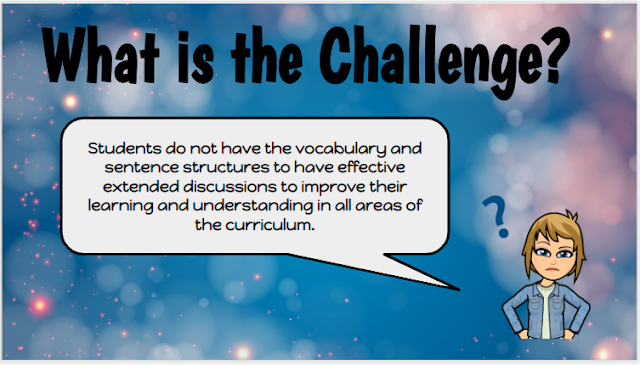

We began the first morning with a role play.  Jenny was the Principal of Omaha Area School, Dorothy the Board Chair, Matt a 'surprise' ERO representative and the rest of us were parents of children attending the area school.  We were given specific roles to play, so you had to think carefully about what that person might be interested in, might get upset by and play your role as best you could.  The meeting was to highlight to the community the challenges that the school or students were facing.  It wasn't until after a few challenges that I realised that these were OUR challenges, our Moonshot Proposals that we had posed in our initial interview to be part of MIT 2023.  This was such a powerful way of sharing our proposals and alerting us to the fact that they were perhaps too wordy, that there were several challenges wrapped up in the one challenge and that they weren't clear enough to actually go about solving them.

Next it was our turn!  We buddied up and worked out how to share, using role play, what our challenge looked like for the learner and the teacher.  I worked with Gabe and as we chatted about my challenge he very quickly knew what he needed to do, as the student, to share what this looked like.  I was his student in his role play who was having trouble understanding what the maths problem was actually asking me to do.

I even made a cameo appearance in Essie and Jayne's role play!😆


Design Process

The first step in the design process involves learning as much as possible about the problem by understanding both the context of the situation and understanding the problem at hand from the perspective of the 'user'.  The role plays helped to get us thinking about our users and the impact on them.  The users in my case being myself as the teacher and the student who is experiencing this challenge with oral language.  During this process you can really empathise with each user to understand someone's experience through answering 4 questions:

  1. What does your user do?
  2. What does your user say?
  3. What does your user think?
  4. What does your user feel?


Working through this process the biggest revelation to me was that both users would have very similar feelings and I felt they would be ones of confusion, frustration and helplessness.

Interpretation - How Might We? - HMW?

We now needed to define our problem or challenge.  My initial challenge was very wordy and clunky:

"Students do not have the vocabulary or sentence structures to have effective extended discussions to improve their learning and understanding in all areas of the curriculum."

Through sheer grit and determination, some wonderful interjections from my fabulous colleagues and being given the magic of, HMW it transformed into:

"How might we explicitly teach students to effectively communicate their ideas?"

This was my stand out moment of the work we did in Omaha.  My wordy, clunky, quite negative sounding challenge turned into a positive sounding opportunity.  An opportunity that made me feel excited to get started on.

We took a break from thinking about our own opportunities and made suggestions on our colleagues' charts.  We were given some very handy sentence starters to frame our suggestions for each other.

Who?
Who does this Moonshot project involve?
Who am I collaborating with on this project?
Who are my team?
Who has a voice in this project?

It was interesting to really reach out and think about who could be valuable to me in this project.


Ideation
Our last activity, before we left the beautiful Omaha, was something called the Crazy 8's.  You had to think of 8 different ways you might solve your challenge.  You could be as original and creative as possible.  The idea being that the first few ideas would be easy to come up with and then it would be harder and harder to fill the last ideas.  

Once you had completed your ideas, you then shared these back to the group so that then they could come round and sticker or stamp their favourite options.  As a final round we had to go back and sticker or stamp our one favourite idea from each Crazy 8 presentation.  This meant we ended up with 1 or 2 clear favourite options.


This was so useful to start thinking about how I might solve my challenge and what other people valued as good ideas as well.  

What an amazing couple of days!  We covered so much, thought a lot, talked a lot and got so much achieved.  I can't wait until we meet up again at the end of the month in Auckland😊

Monday, September 14, 2020

Week 9 - DFI Finale

The end is here, we have made it and I am going to miss our Tuesday sessions that have been full of thinking and learning. What an amazing course, lots of talk about the pedagogy behind Manaiakalani, which then makes you think about your own teaching pedagogy and what needs to be adjusted to fit with your new ideas and beliefs.  I think the big learning I am taking away is that teaching needs to be:

  • visible
  • rewindable
  • a variety of multimodal content
  • ubiquitous access to learning, i.e. could the child learn by self 
  • connected (blog links, other sites)
  • creative - both in your teaching and learning.
Today we were exposed to the term Ubiquitous Learning - I now know how to say it, so that's a bonus. It means that learning can be Any time, Any where, Any place and From Anyone.  This of course became our Distance Learning from this year. I know after attending this course and what I want to achieve with my new Learning Site that I would be so much more prepared for this if we were to need it again. I think my students would also be more prepared and I really liked the idea of having "Google Meet Drill" opportunities while we are at school to ensure that if we were to go back into lockdown my students are ready and have the skills to engage in meetings by distance.

The fact that my daily teaching is becoming more visible, rewindable and ubiquitous I am loving the fact that if students are going to be away for any reason I can just let their parents know that the Learning Site will have all the learning for Maths and Literacy so they don't need to miss out. Eventually I want my students to know that they can just tell their parents that all the learning they will be missing will be on the Learning Site and there is no need to ask me for work.

So where to from here? I will continue working on my Learning Site and I want to change my planning so I am taking note of what digital areas I am covering, either in explicit teaching to my students or what they are using to create and then share their learning. I still need to think about how to integrate blog posts and commenting into my week and make it second nature for my students. I also need to make time to do blog commenting myself and how I see this fitting into my regular weekly timetable. I think these next holidays will be a good chance to have a catch-up and a think about how this will all look. Trial it for Term 4 and then be ready to hit the ground running for Term 1, 2021.

Tuesday, September 8, 2020

Week 8 - Computational Thinking

A few years ago when I taught in a 1:1 ipad class our message to parents was that the ipad was 'just a tool'.  This was to ensure the parents weren't worried that the classes who were 1:1 weren't just going to plug their child into a device and leave them to it for the day. Back then it was just a tool, although it did have the ability to create a new eagerness and interest in learning for our students.  The only part it was missing was the Share part. I can now understand the whole process Learn, Create, Share and how important the Share part of this process is. The students in my class are really starting to connect with the fact that they do get comments on their blogs and they can reply to them. The replying step is quite new to lots of them but it is really deepening the connections that are being made to their learning process.

I found the information that was shared on the Digital Technologies Curriculum very timely and very informative. Something that really stood out for me was the fact that we can easily be keeping a record of what we are covering in the Designing and Developing Digital Outcomes part by just noting it in our planning. For example if the expectation is that the students will share their learning in a Google Drawing and insert an image in the background (playing around with the transparency setting) then this can be noted in your planning and there is the link and coverage of that part of the curriculum. As the children have more and more tools in their toolkit then the choice can be up to them how they want to present their learning. Just this week I have set my students the task of researching an item of technology that they feel has changed their lives or the lives of others and I have given them the freedom to choose how they want to present their findings. When we share these with the whole class the discussion can also be about what tool was used to present the information and this will help students make their choices in future tasks.


It was fun to have a go with some of the different coding resources available to us. I think I will make this part of my programme some how. I need to find out what experience my students have had in this area and then go from there. There was a fun Dance Party type activity in one of the Hour of Code online resources that would be quite fun to use as an absolute beginning point to coding but if my students already have some knowledge then this wouldn't be of any benefit to them at all - other than the entertainment value! Scratch is by far more advanced, and I think it would be quite a good resource to use as a whole class where I also learn alongside my students and role model being a learner, asking for support from others, struggling and persevering to complete the task. I think I will timetable this in over the next couple of weeks of term and see how it goes. I can then add it into my Must Do activities - where I set them a certain task or the Can Do area for children to work on when they have finished other tasks.


Monday, August 31, 2020

Week 7 - Devices

Through the Manaiakalani pedagogy the belief is that we are empowering our learners as connected and confident decision makers.  Sharing their learning on their blogs is personal and the students need to decide what they want to share, what they want to put out there into the world to be 'judged'. This is where the commenting system of Positive, Thoughtful, and Helpful safeguards our learners and ensures they want to keep posting their learning online. I really connected with this quote from Lee Anne Lindsey (2017) where she said that when taught in a positive light, digital citizenship helps them navigate effectively through the digital world resulting in healthy interactions, a positive digital presence and increased learning opportunities.

This week we had some time to work on a Chromebook - the device used by the students in my classroom.  This was a beneficial session to use the same device as what my students use every day to become more familiar with this.  There are lots of shortcuts, I wonder if there are actually too many to remember but obviously the more you use something the more familiar it will become.  I have noted some of the shortcuts I think my students should know and should use.  I will add these into my digital learning sessions each week and the students will use them or not, to suit. 


We were reminded about Screencastify and Explain Everything.  I need to find something similar to use on a Chromebook that doesn't require a subscription.  I have had my students use Google Drawings with Screencastify to explain their maths learning but just wonder if there is something better than this.  My goal is to get my students using Screencastify a lot more - such a valuable tool to get them to verbalise their learning. 


MPI - Create and Share in Mathematics

  Our last day of the Mathematics Practice Intensive for 2024!  I have to be honest and say that I will miss the sessions and all of the won...